My 7-year-old learned the emergency numbers from an app I vibecoded in 3 nights
April 2026
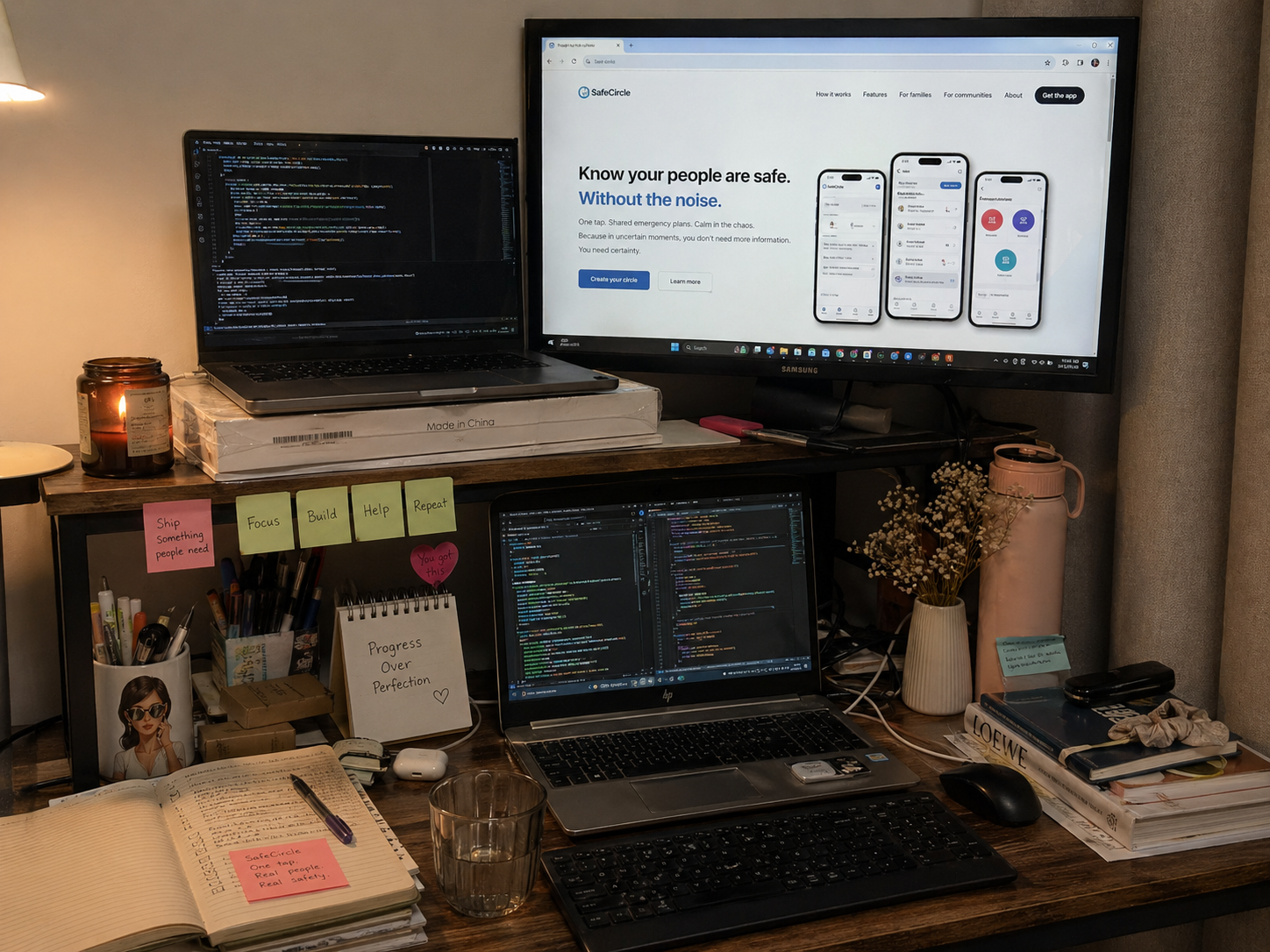
I started vibecoding in November 2025. Six months in, I've shipped 5 apps, but only one earned a special place in our family's daily rhythm. Here's what I built during the recent Iran conflict exchange, what surprised me, and what 3 nights of crisis-coding taught me about trust infrastructure.
I was sitting on my kitchen floor in Dubai, holding my phone, when I realized I had been refreshing the same 5 news tabs for an hour.
The US, Israel, and Iran were exchanging strikes and while the UAE government was doing a great job keeping us safe and informed, I needed something more specific. I needed to know that my people, by name, were okay. Not the news, them. Without having to message or call every time I saw a new update or heard a rumor.
That's when I decided to stop hanging up to my phone, take a step back, and act. I closed every tab I had open and opened Claude Code.
3 nights later, SafeCircle was running.
How I got there
I'm not a developer. I've spent the last decade in MarComms, across brand, content, and strategic communications for SaaS, outdoor media, and public institutions. Until November 2025, I had never deployed a line of code.
I started vibecoding because I watched a relative do it. He'd ship something on a Tuesday and have feedback by Wednesday. I joined the solopreneur community on X. I read Marc Lou shipping daily. Pieter Levels building 12 startups in a year. I thought: if they can, I can. So I tried.
SafeCircle is the latest thing I vibecoded. It works.
What SafeCircle actually does
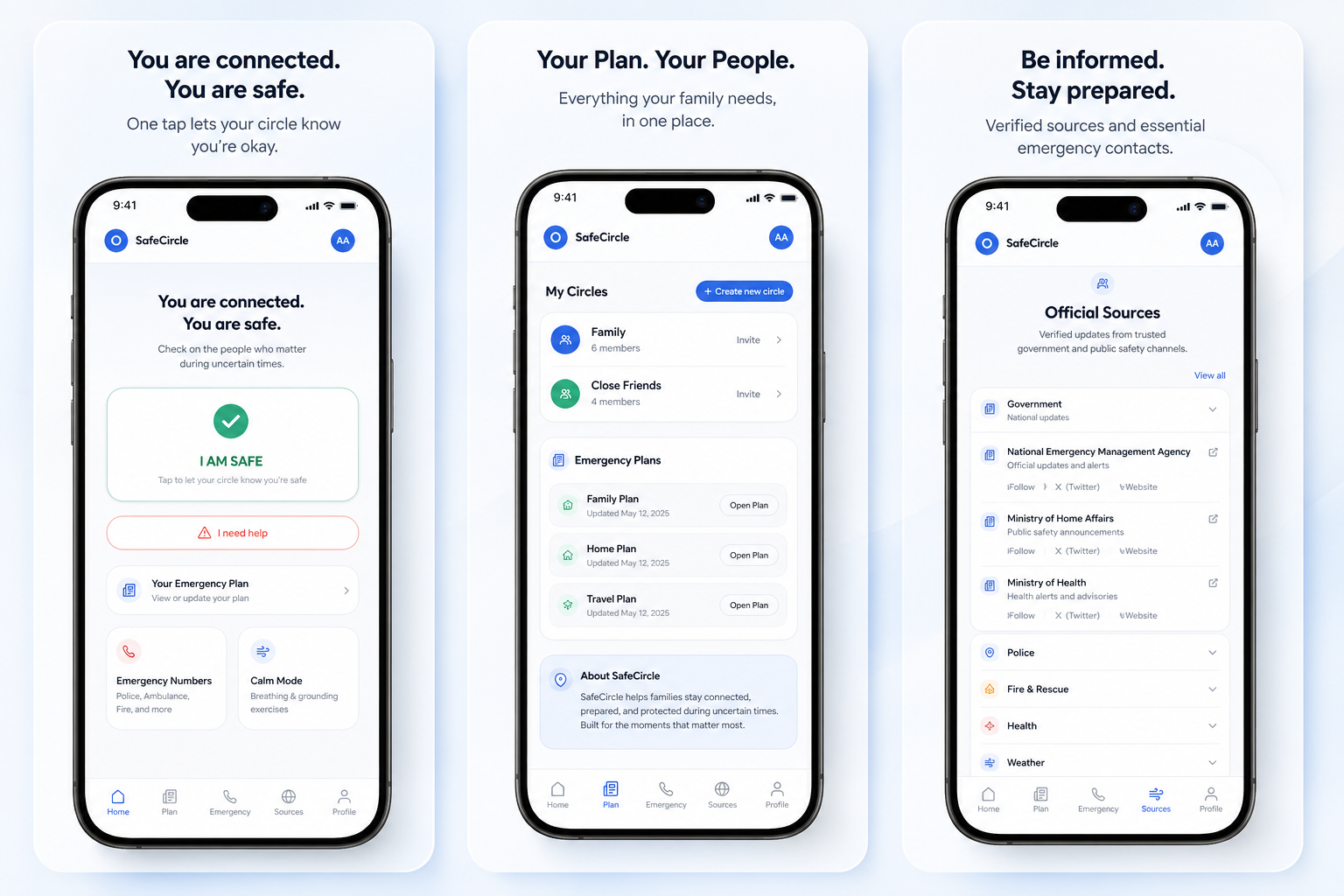
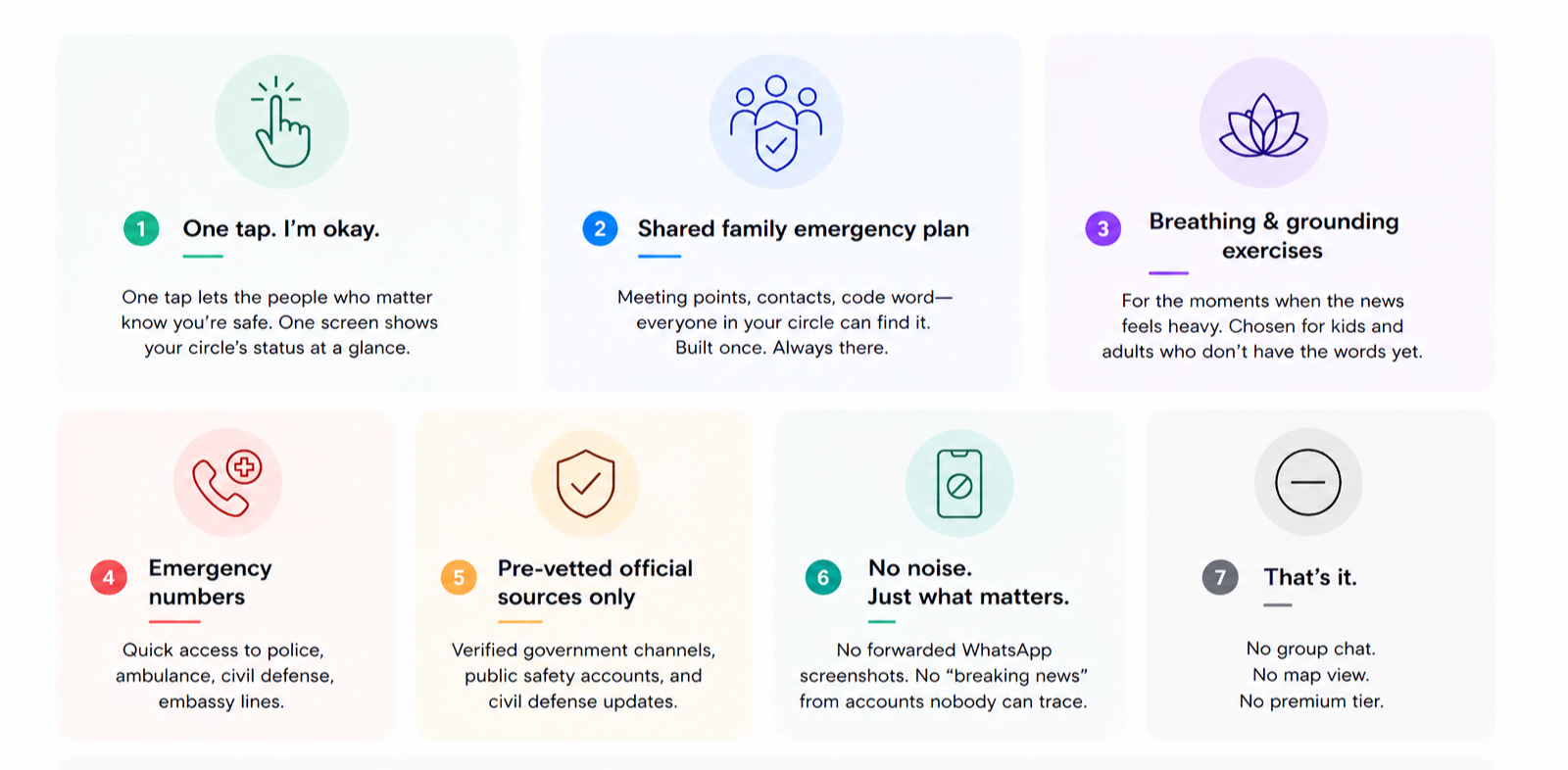
The unexpected user
I built SafeCircle for my relatives. The first person who actually changed how she lived with it was my daughter. She's 7.
In a few days, she had the UAE emergency numbers memorized. Not because I taught her, but because she saw them every day on the app I was building. Then she found the breathing exercises and the grounding scripts. She started using them on her own when homeschooling felt hard and she missed her friends. Now that she's back at school, she still turns to them after difficult days. Sometimes she blurts out the emergency numbers with excitement whenever she sees a police car, officers, a station, or hears sirens pass by.
She knows what to do when something feels wrong, and the steps to take.
I've spent years building MarComms campaigns to reach hundreds of thousands of people. None of them did what a 3-night vibecoded app did for one 7-year-old: gave her a system she could actually use when she was scared.
The "no bother" dynamic, and why it's the real value prop
In the first week of using SafeCircle, I stopped sending "are you ok?" messages. So did everyone else in my circle. Why? Because the answer was already on the app.
I would open SafeCircle in the morning. Everyone was green. I would close it. That was the check-in. No forced "Hi, are you safe?" message that interrupts someone who's trying to sleep, or work, or just sit quietly because the news has been too much for too long.
This is the part most people miss about crisis communication: the cost isn't the message. The cost is the social pressure to respond.
When you're scared and tired, the worst thing isn't the silence. It's different people asking "are you ok?" and the obligation to answer all of them with composure you don't have.
SafeCircle removed the obligation. One tap. I'm okay. Everyone can see. Nobody has to be performed-at.
That's the insight I would never put in a marketing playbook, because it's the opposite of how marketing thinks. Marketing thinks more touchpoints = more connection. In a crisis, the opposite is true: fewer obligations to respond = more genuine care.
Why my safe circle became safe circles
For the first few days, SafeCircle was just for my circle. Then they started sharing it with theirs. That's when the question came up: why not open it to everyone? I hesitated. SafeCircle works because it's small. Because it's personal. The moment you try to make it "for everyone," you risk losing that. It becomes noise. It becomes just another app.
I still decided to open it. Not to scale it fast, but to let it exist for others who might need it. I didn't change the core of it. And I didn't switch into growth mode. No campaigns, no push to drive users. I let it spread the same way it started, from one circle to another.
Because it's not for everyone. It's for small groups of people who care about each other, and who simply want to know that the people they love are okay.
The lesson is not about war
Most readers will never live through one. I'm not writing this to make my situation universal. But almost everyone, at some point, has been afraid for someone they couldn't reach. A parent waiting to hear from a child travelling. A daughter watching a mother in a hospital from another time zone. A friend whose partner is in a city when the news flashes. A community when one of them goes silent.
The crisis doesn't have to be a war. It can be a hurricane. A hospital. An accident. A long flight. A country in the headlines for the wrong reason. The shape is the same: distance, danger, and the gap between I hope and I know.
SafeCircle is for that gap. Not the war. The gap.
Those days were intense. But what those 3 nights of building gave me, and what surprised me most, wasn't a feeling of safety. It was a habit of presence.
We still open SafeCircle every day. The crisis is over. The check-in stayed. My daughter still uses the breathing exercises. The official sources section is still the first place we check when something happens. It became a habit, and an important one: always go to official sources.
That's what trust infrastructure actually means: the small systems that outlive the moment that built them.
My wish is that war will one day desapear and SafeCircle won't be needed in a crisis. But it can still be useful for people who simply want to stay connected to their circle.
I'm also sharing this for another reason: to show that this is possible. I'm not a developer, and I built this. Tools are evolving fast.
If you try it, I would genuinely value your feedback. It's not perfect yet, but I'm working on making it stable enough for everyday use.
If you're in a moment of distance from someone you love, even if there's no crisis, even if the news is calm, SafeCircle is open.
It's for circles, not crowds.
Related Articles
The One-Hour MVP: Why Constraints Create Clarity
I didn't sit down with the intention of speed. I sat down with a need for truth.
Read more →It All Started with a Notebook and a Pen
When my previous role came to an end, the first tool I reached for wasn't my laptop. It wasn't LinkedIn. It was my daughter's Grade 1 spelling notebook and a pencil.
Read more →From a Broken Football Dream to Building a Future: The Man Redefining Impact Without Showing Suffering
A profile of Issouf Safo Koné and AN KA SININASIGI, written with a deliberate craft line: the impact should not require humiliation. Includes a working framework for dignity-led storytelling in mission-driven communications.
Read more →Stay Updated
Get notified when I publish new reflections, insights, and behind-the-scenes updates.