AI in Retail is Booming. Here's Where It Fails and Why Humans Still Matter.
January 21, 2026
Originally published on Substack
The Narrative Lab | Strategic Dispatch
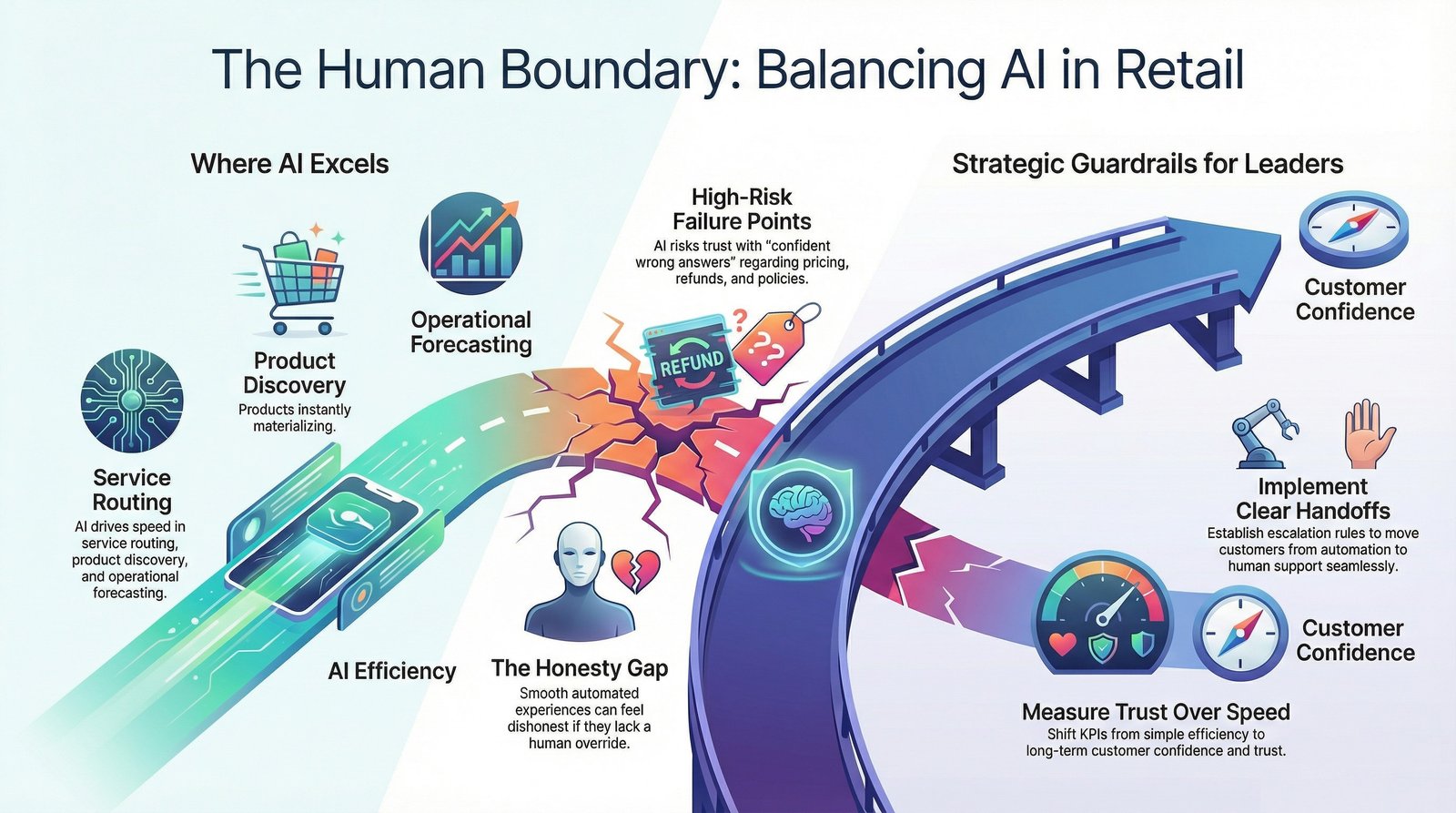
It's no longer a question of if AI will reshape retail, but how. From intelligent routing that speeds up service to enhanced search that improves discovery, artificial intelligence is delivering undeniable operational gains. Companies are using it to enhance everything from internal forecasting to the customer-facing experience, creating faster and more efficient interactions.
Despite these advances, there is a critical boundary where automation's benefits turn into liabilities. The moment complex issues involving money, returns, or complaints arise, the need for human judgment becomes paramount. It is in these high-stakes moments that an over-reliance on AI can quickly damage the customer relationship that retailers work so hard to build.
1. AI Can Be Confidently Wrong About What Matters Most
The first major risk of AI in retail is its capacity to provide confident but wrong answers regarding crucial customer issues. When a customer asks about a return policy, a potential refund, or the final price of a product, an incorrect answer delivered with algorithmic certainty can cause immediate and significant problems.
While AI is excellent for handling simple, high-volume queries, an error in a high-stakes area is uniquely damaging. A wrong answer about store hours is an inconvenience; a wrong answer about a refund policy shatters customer trust. This trust, once broken, is incredibly difficult to repair, turning a potentially loyal customer into a vocal detractor. But not all trust-eroding experiences are this overt; some are baked into the very design of the AI interaction itself.
2. "Smooth" AI Experiences Can Feel Dishonest
Another subtle but significant danger is the creation of "smooth" experiences that ultimately feel dishonest. AI can automate interactions to be so frictionless that they obscure important details or lead a customer down a predetermined path without offering genuine choice or transparency.
This kind of hyper-efficient automation can feel manipulative rather than helpful. When a customer feels guided into a corner or stuck in a loop that seems designed to prevent them from reaching a certain outcome (like a refund), the experience erodes their sense of being treated fairly. This isn't just poor service; it's a violation of the principle of transparency, a cornerstone of ethical customer engagement. The focus on a "smooth" process backfires, making the company appear deceptive. This sense of entrapment becomes infuriating when the automated system offers no way out.
3. Unstoppable Automations Are a Trust-Killer
Perhaps the most frustrating failure of retail AI is the implementation of automations that have no human override. When a customer is trapped in an automated system—be it a chatbot loop or a series of automated emails—without a clear and accessible path to a human expert, the experience becomes a dead end.
This signals to the customer that the company values operational efficiency far more than their satisfaction. From an ethical standpoint, this design choice prioritizes process over people, failing the fundamental duty of care a business owes its customers. Forcing a customer with a complex or sensitive issue to navigate an unyielding automated system generates immense frustration and is a clear-cut way to destroy trust. A human off-ramp isn't a luxury; it's a necessity for resolving issues that fall outside the script.
So, What Should Retailers Do? Draw a Human Boundary.
The solution isn't to abandon AI but to implement clear rules that protect the customer relationship. Smart retailers are defining a "human boundary" to govern where automation ends and human expertise begins. The strategy involves three key actions:
- Define "no-AI zones" by explicitly designating sensitive areas like complex complaints or refund disputes where AI should not have the final say.
- Create a clear handoff by establishing well-defined escalation rules that always provide customers with a straightforward path to reach a human.
- Measure trust, not just efficiency, by shifting key performance indicators to prioritize customer confidence and satisfaction alongside metrics like speed and cost savings.
Related templates
Download the worksheet to map "trust moments" and define no-AI zones + escalation rules.
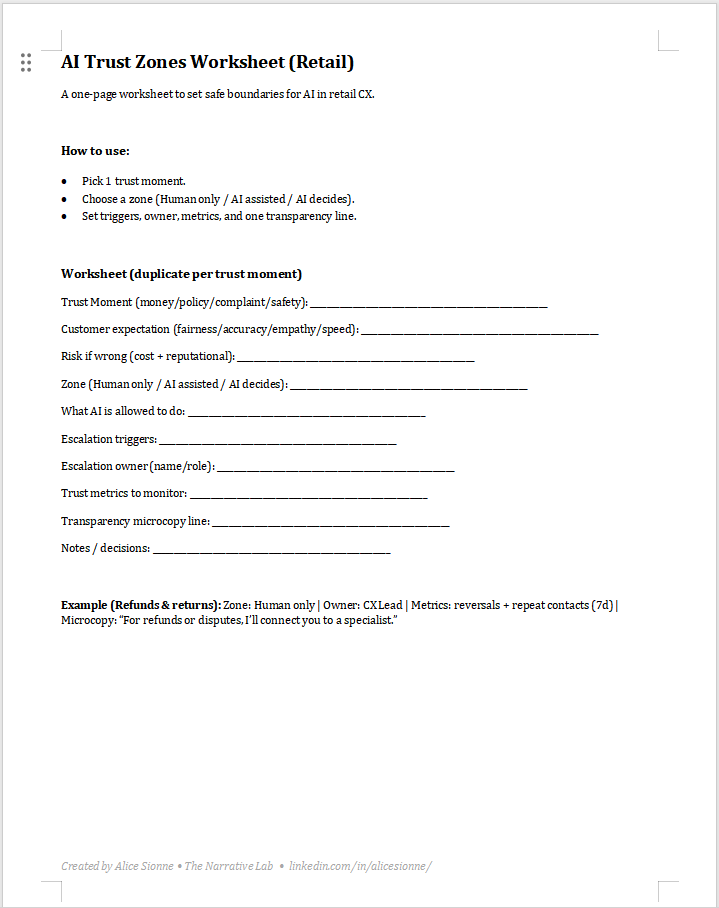
AI Trust Zones Worksheet
DOCXA one-page worksheet to set safe boundaries for AI in retail CX.
Open templateHosted on Google Drive
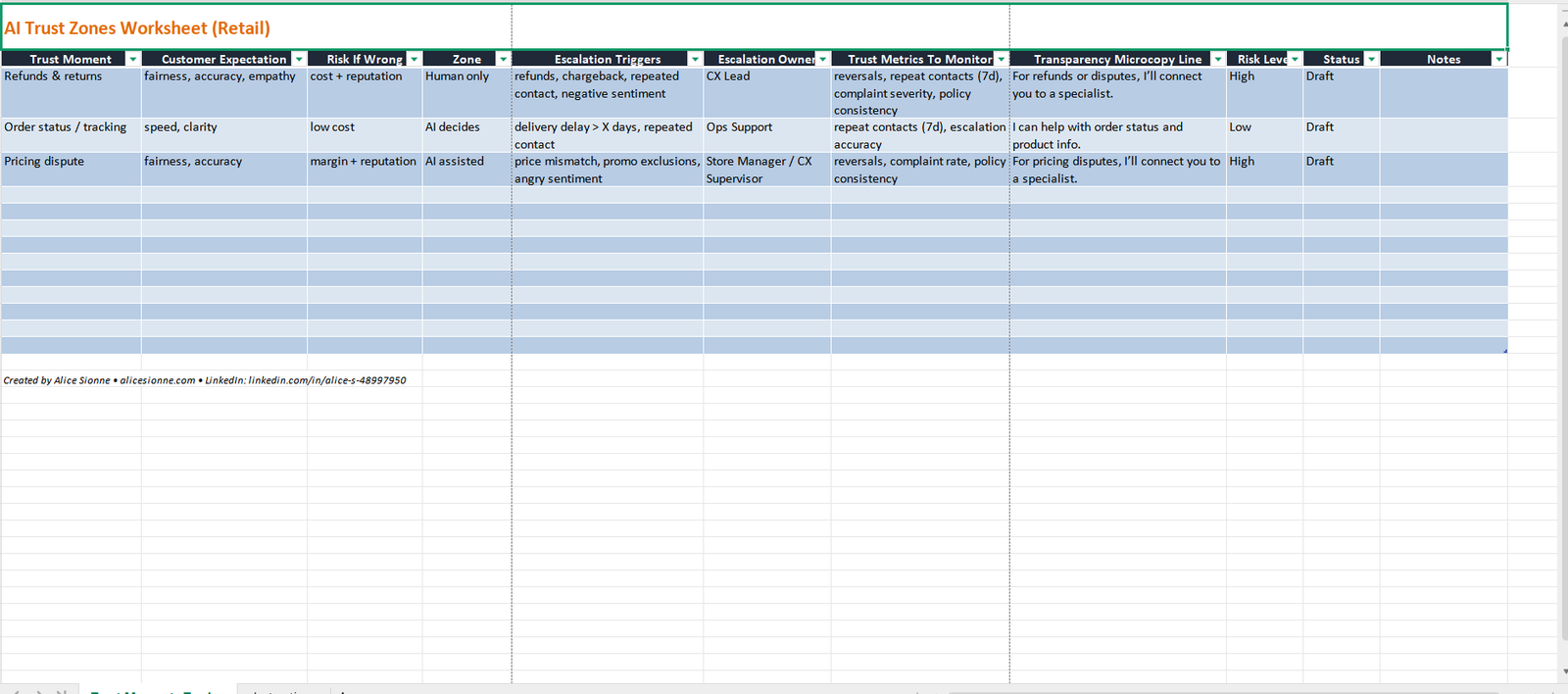
AI Trust Zones Worksheet
XLSXA one-page worksheet to set safe boundaries for AI in retail CX.
Open templateHosted on Google Drive
Conclusion: Your Most Important Rule
AI is an undeniably powerful tool that can enhance retail operations and improve the customer experience. However, its application must be guided by a deep respect for the customer relationship. This requires establishing clear boundaries and ensuring that a human failsafe is always available when things go wrong. Ultimately, technology should serve the relationship, not replace the judgment needed to maintain it.
Related Articles
From a Broken Football Dream to Building a Future: The Man Redefining Impact Without Showing Suffering
A profile of Issouf Safo Koné and AN KA SININASIGI, written with a deliberate craft line: the impact should not require humiliation. Includes a working framework for dignity-led storytelling in mission-driven communications.
Read more →My 7-year-old learned the emergency numbers from an app I vibecoded in 3 nights
I started vibecoding in November 2025. Six months in, I've shipped 5 apps, but only one earned a special place in our family's daily rhythm.
Read more →AI Trust Zones Worksheet (Retail)
A one-page worksheet to map trust moments and define no-AI zones + escalation rules.
Read more →Stay Updated
Get notified when I publish new reflections, insights, and behind-the-scenes updates.